
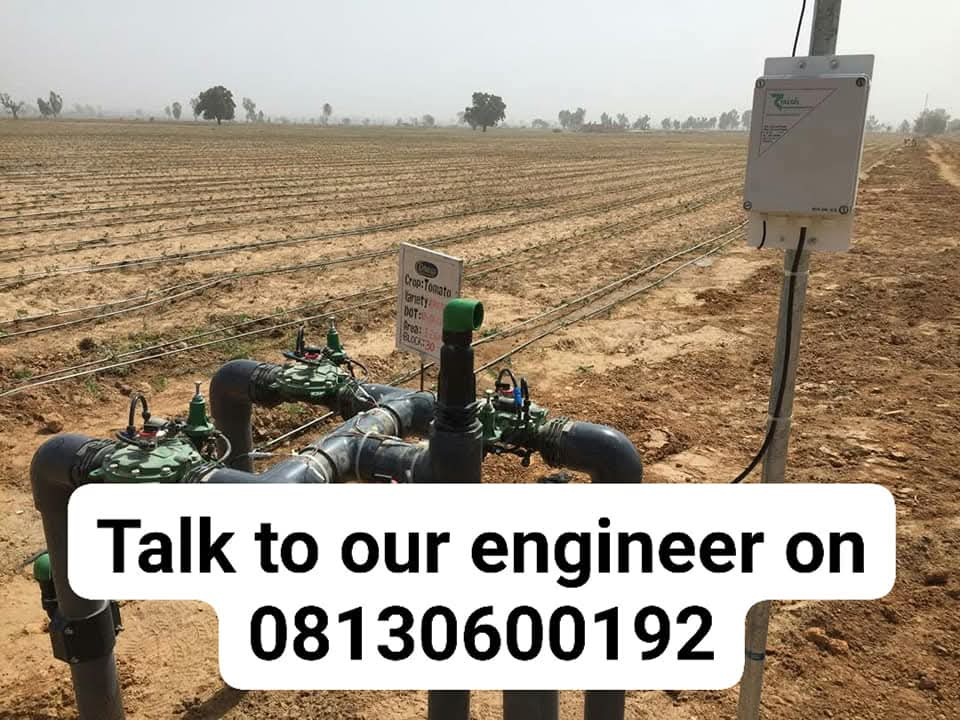
Smart Irrigation Installation Nigeria
Smart Irrigation Installation Nigeria
Smart irrigation installation in Nigeria is becoming an essential investment for farmers, agribusiness owners, greenhouse operators, commercial farms, estates and agricultural investors seeking to improve productivity, conserve water and reduce the cost of manual irrigation. With changing weather patterns, irregular rainfall, rising labour costs and the growing demand for food production, adopting modern irrigation technology can help Nigerian farmers maintain consistent crop growth throughout the year.
Irrigrow Civil & Engineering Limited provides engineering-driven agricultural irrigation solutions designed to help farms use water more efficiently. Our services cover smart irrigation system planning, drip irrigation installation, sprinkler systems, automated watering systems, greenhouse irrigation, solar-powered irrigation, water storage infrastructure and agricultural water management solutions.
Whether you operate a small vegetable farm, a commercial greenhouse, a large-scale crop plantation or an agricultural estate, investing in a properly designed smart irrigation system can help you improve water distribution, reduce unnecessary water usage and maintain more consistent soil moisture for healthy crop development.
At Irrigrow Civil & Engineering Limited, our approach combines agricultural water management with practical engineering solutions to deliver irrigation systems suited to the Nigerian environment. We consider farm size, crop requirements, water availability, soil conditions, topography, energy supply and operating costs when planning an irrigation installation.
If you are searching for smart irrigation installation in Nigeria, Irrigrow Civil & Engineering Limited can help you plan, install and maintain an irrigation solution that supports your agricultural objectives.
What Is Smart Irrigation?
Smart irrigation is an advanced method of supplying water to crops using automated equipment, sensors, controllers and carefully designed irrigation networks. Unlike traditional watering methods that depend entirely on manual labour or fixed watering schedules, smart irrigation systems can adjust water delivery according to soil moisture, crop requirements, weather conditions and programmed irrigation schedules.
A smart irrigation installation may include soil moisture sensors, temperature and humidity sensors, water-level sensors, automated valves, pumps, filtration equipment, irrigation pipes, drip emitters, sprinklers and a central controller. Depending on the design, the system may operate automatically or allow farmers to monitor and control irrigation through a smartphone, computer or dedicated control panel.
For example, a farmer cultivating tomatoes in a greenhouse can install soil moisture sensors to monitor the water content of the growing medium. When moisture levels fall below a selected threshold, the controller can activate the pump or open an irrigation valve. Once the required moisture level is reached, the system can stop watering.
This approach helps reduce unnecessary watering while ensuring that crops receive water when they need it.
In Nigeria, smart irrigation can be applied to vegetable production, maize cultivation, rice farming, cassava plantations, plantain farms, fruit orchards, nurseries, greenhouse agriculture and many other agricultural activities.
Smart Irrigation Installation Services in Nigeria
Irrigrow Civil & Engineering Limited provides irrigation engineering services for agricultural projects of different sizes. Our solutions can be tailored to individual farmers, commercial agricultural enterprises, greenhouse operators, institutions and agricultural development projects.
1. Smart Drip Irrigation Installation
Drip irrigation is one of the most efficient methods of delivering water directly to the root zone of crops. Water passes through a network of pipes, laterals and emitters, allowing it to reach individual plants or selected growing areas.
Our smart drip irrigation installation services can include the design and installation of water storage tanks, pumps, filters, mainlines, sub-mainlines, drip tapes, drip lines, emitters, pressure regulators and automated control valves.
Drip irrigation is particularly suitable for tomato farming, pepper cultivation, cucumber production, onions, vegetables, plantain, fruit crops and greenhouse farming.
When combined with smart controllers and soil moisture sensors, drip irrigation can become an automated water management system that delivers water according to crop requirements.
The benefits include more controlled water application, reduced surface runoff, improved moisture management and less dependence on manual watering.
2. Automated Irrigation Systems
Automated irrigation systems reduce the need for farmers to switch pumps and valves on and off manually throughout the day.
An automated irrigation installation can use timers, programmable controllers, moisture sensors, water-level sensors and electrically operated valves to regulate watering.
For example, a farm can be divided into irrigation zones, with each zone receiving water according to its crop type, soil characteristics and water requirements.
A greenhouse growing cucumber may require a different irrigation schedule from an outdoor vegetable plot. A properly configured controller can accommodate these differences.
Irrigrow Civil & Engineering Limited can help plan automation around the farm’s actual requirements, whether the project requires a basic timer-based system or a more advanced sensor-driven arrangement.
3. Greenhouse Irrigation Installation
Greenhouse farming requires careful management of water, temperature, humidity and the growing environment. Excessive watering can contribute to root problems, while insufficient irrigation can stress plants and reduce crop performance.
Our greenhouse irrigation solutions can incorporate drip lines, fertigation equipment, pumps, filtration units, water storage tanks, irrigation controllers and environmental monitoring sensors.
For suitable projects, sensors can monitor air temperature and humidity alongside soil or growing-medium moisture. These measurements can support irrigation decisions and help farmers identify environmental conditions that require attention.
Greenhouse irrigation systems can be designed for tomatoes, cucumbers, sweet peppers, lettuce, herbs and other crops commonly cultivated under protected agriculture.
We consider greenhouse dimensions, crop spacing, water supply, growing medium and available power when planning the installation.
4. Solar-Powered Smart Irrigation Installation
Reliable power supply is an important consideration for agricultural operations in Nigeria. Farms located far from the national electricity grid may face high diesel costs or interruptions that affect irrigation schedules.
Solar-powered irrigation uses photovoltaic panels to supply electricity to a compatible water pump and associated control equipment.
Depending on the system design, solar irrigation may operate during daylight hours, use a storage tank to retain pumped water or incorporate batteries where continuous electrical operation is necessary.
A solar-powered smart irrigation project may include solar panels, mounting structures, a pump, a controller, water storage infrastructure, filtration equipment, pipelines and automated irrigation components.
Proper system sizing is important. Pump selection should account for the required water volume, pumping head, pipe friction losses and daily irrigation demand.
Irrigrow Civil & Engineering Limited can help evaluate these requirements to develop a practical irrigation arrangement for farms, greenhouses and agricultural plantations.
5. Sprinkler Irrigation Installation
Sprinkler irrigation distributes water through nozzles that spray it over crops or designated agricultural areas. It is useful for selected field crops, nurseries, lawns and other applications where overhead water distribution is appropriate.
A sprinkler installation may include pumps, main pipes, distribution lines, risers, sprinkler heads, valves, filters and controllers.
Smart controls can divide the farm into irrigation zones and regulate operating schedules.
The suitability of sprinkler irrigation depends on the crop, soil, wind conditions, water pressure and water quality. Some crops are better served by drip irrigation, particularly where water must be delivered directly to the root zone or foliage wetting should be limited.
Our irrigation planning process considers these factors before recommending a system.
6. Soil Moisture Sensor Installation
Soil moisture sensors help farmers understand how much water is available within the root zone. Instead of relying entirely on visual observation or fixed watering schedules, farmers can use sensor readings to make better-informed irrigation decisions.
A smart irrigation system may use sensors connected to a microcontroller or dedicated irrigation controller. When soil moisture drops below a selected threshold, the system can trigger watering, subject to the controller’s operating rules.
More advanced installations can monitor several locations across a farm because soil moisture may vary between different beds, soil types or irrigation zones.
Sensor placement and calibration are important for obtaining useful readings. The appropriate installation depth depends on crop rooting depth, soil conditions and the irrigation method.
Irrigrow Civil & Engineering Limited can incorporate soil moisture monitoring into new irrigation installations or suitable existing irrigation networks.
7. Water Storage, Pumping and Distribution Infrastructure
An effective smart irrigation system requires more than sensors and automated valves. It also needs a dependable source of water and a properly designed distribution network.
Depending on the project, this infrastructure may include boreholes, water storage tanks, reservoirs, pumps, filters, pressure regulators, pipe networks and drainage provisions.
Water storage can help farms manage variations in supply and coordinate irrigation with solar pumping schedules. Proper filtration can also protect drip emitters and sprinkler nozzles from clogging.
Pump selection should be based on the system’s flow rate, total dynamic head, operating pressure and energy requirements rather than choosing equipment based on motor power alone.
Our engineering approach considers the entire water delivery system to help ensure that the irrigation equipment works together effectively.
Why Smart Irrigation Is Important for Nigerian Farmers
Agriculture in Nigeria operates across different climatic zones, soil types and rainfall patterns. Farmers in the northern regions may experience prolonged dry periods, while other areas experience seasonal rainfall, flooding or uneven water distribution.
Smart irrigation provides a way to manage water more deliberately and reduce reliance on rainfall alone.
Improved Water Management
Traditional irrigation can result in overwatering, uneven distribution or water loss through runoff and evaporation. Smart irrigation allows farmers to control when, where and how much water is applied.
Drip irrigation can deliver water directly to plant roots, while sensor-based controls can help prevent irrigation when the monitored soil is already sufficiently moist.
The actual water savings depend on the existing irrigation method, crop, soil and system design.
Reduced Manual Labour
Manual watering can become expensive and time-consuming as a farm expands. Automated pumps, valves and controllers can reduce the amount of labour required for routine irrigation activities.
Farm workers can then spend more time on crop monitoring, harvesting, pest management, maintenance and other agricultural operations.
Automation does not eliminate the need for farm personnel. Filters, pipes, emitters, sensors and pumps still require inspection and maintenance.
More Consistent Crop Water Supply
Plants need an appropriate balance of water and oxygen around their roots. Both water stress and excessive watering can negatively affect crop performance.
Smart irrigation can help maintain more consistent moisture levels by applying water according to crop requirements and field conditions.
This is particularly useful in greenhouse production and high-value vegetable farming, where irregular watering can affect plant growth and fruit quality.
Support for Dry-Season Farming
Dry-season agriculture creates opportunities for farmers who have access to reliable water sources and appropriate irrigation infrastructure.
A properly designed irrigation system can help farmers cultivate crops outside the main rainy season, subject to water availability, market conditions, crop suitability and operating costs.
With suitable pumping, storage and distribution equipment, farmers can plan irrigation schedules around their production objectives rather than depending exclusively on rainfall.
Potential to Improve Farm Productivity
Adequate water management supports crop development, nutrient uptake and healthy root systems. However, irrigation alone does not guarantee higher yields.
Crop performance also depends on seed quality, soil fertility, pest control, disease management, temperature, planting density and general farm management.
Smart irrigation works best as part of an integrated agricultural production strategy.
Crops That Can Benefit From Smart Irrigation in Nigeria
Smart irrigation can be adapted to many agricultural activities, although the irrigation method must suit the crop and growing conditions.
Tomato Farming
Tomatoes require careful water management throughout their growth cycle. Drip irrigation can provide controlled water delivery to the root zone and help maintain more uniform moisture conditions.
Automated irrigation can also help farmers coordinate watering with fertiliser application where a suitable fertigation system is installed.
Pepper and Vegetable Farming
Pepper, cucumber, leafy vegetables, onions and other horticultural crops can benefit from well-designed drip irrigation systems.
Smart irrigation is especially useful where crops are planted in beds or rows that can be organised into manageable irrigation zones.
Plantain and Banana Plantations
Plantain and banana production can benefit from irrigation during periods when rainfall is insufficient.
Drip irrigation or other suitable low-pressure systems can be designed around plant spacing, soil conditions, water availability and plantation size.
Large plantations may require several irrigation zones to achieve appropriate pressure and distribution.
Maize and Other Field Crops
Maize, selected legumes and other field crops can benefit from irrigation where seasonal rainfall does not meet their water requirements.
Depending on field size, soil conditions and available water, farmers may consider sprinkler irrigation, drip irrigation or other suitable distribution methods.
Greenhouse Crops
Greenhouse production is a strong application for smart irrigation because water delivery can be coordinated with crop spacing, growing medium, environmental monitoring and fertiliser management.
A greenhouse system can be designed to automate selected tasks while allowing the operator to monitor performance and intervene when necessary.
Fruit Orchards and Commercial Farms
Fruit crops and other perennial plants may benefit from irrigation systems designed to deliver water around the active root zone.
For larger farms, dividing the irrigation network into zones can make it easier to manage different crop blocks and varying water requirements.
Our Smart Irrigation Installation Process
At Irrigrow Civil & Engineering Limited, a successful installation begins with understanding the farm rather than simply supplying pipes and pumps.
Step 1: Site Assessment
The first step is to evaluate the proposed installation site. Important considerations include farm size, terrain, soil conditions, crop type, existing infrastructure, water source and access to electricity or solar power.
A site assessment helps identify potential design challenges and determines the information needed for system sizing.
Step 2: Water Source and Availability Assessment
The available water supply must be assessed before selecting the irrigation equipment.
Depending on the project, the water source may be a borehole, reservoir, storage tank, surface water source or another suitable supply.
The assessment should consider available flow, water quality, seasonal reliability and any applicable regulatory requirements.
Where necessary, water testing can help determine the filtration or treatment required to protect irrigation components.
Step 3: Irrigation Design and Planning
After assessing the site and water supply, the irrigation network can be designed around the farm’s requirements.
The design may include pipe routing, irrigation zones, pump capacity, emitter spacing, sprinkler selection, filtration, control equipment and water storage.
A properly prepared design helps reduce the risk of inadequate pressure, uneven watering, excessive energy consumption and unnecessary equipment costs.
Step 4: Equipment Selection
Equipment is selected according to the project’s technical requirements and budget.
Depending on the design, this may include pumps, pipes, drip lines, emitters, filters, valves, sensors, controllers, solar panels and communication equipment.
Components must be compatible with one another and suitable for the operating conditions.
Step 5: Installation and Integration
The installation process involves positioning and connecting the irrigation components, laying pipes, installing valves and emitters, configuring sensors and connecting the control system.
For automated projects, the controller must be configured with appropriate irrigation schedules, sensor thresholds and operating limits.
The installation team should also provide safe electrical connections and appropriate protection for equipment exposed to outdoor conditions.
Step 6: Testing and Commissioning
Before the system is handed over, the irrigation network should be tested for leaks, pressure, flow distribution and correct operation.
Automated systems should also be tested to confirm that sensors, controllers, pumps and valves respond as intended.
Commissioning helps identify problems before the system is relied upon for regular crop watering.
Step 7: Training and Handover
Farm operators need to understand how to operate the system, monitor performance and respond to common problems.
Training may cover controller settings, irrigation schedules, filter cleaning, sensor checks, pump operation, leak detection and basic troubleshooting.
Clear operating instructions can help the farm team use the system more effectively.
Step 8: Maintenance and Technical Support
Routine maintenance helps protect irrigation equipment and reduce avoidable downtime.
Maintenance activities may include cleaning filters, flushing pipelines, checking emitters, inspecting electrical connections, verifying sensor readings and servicing pumps.
Irrigrow Civil & Engineering Limited can discuss maintenance arrangements appropriate to the scope of the installation.
Smart Irrigation Installation Cost in Nigeria
The cost of smart irrigation installation in Nigeria varies according to farm size, crop type, water source, equipment specifications and the degree of automation required.
A small garden or greenhouse may need a relatively simple system, while a commercial farm may require a larger pumping network, several irrigation zones, extensive piping, solar equipment and centralised monitoring.
The main factors affecting the installation cost include:
- Farm size: Larger farms generally require more pipes, emitters, valves and installation work.
- Water source: A project requiring a new borehole or reservoir may cost more than one using an existing, reliable supply.
- Irrigation method: Drip, sprinkler and specialised greenhouse systems have different equipment and installation requirements.
- Automation level: Timers, soil moisture sensors, automatic valves, remote monitoring and advanced controllers influence the final cost.
- Power supply: Grid-powered, generator-powered and solar-powered systems have different capital and operating costs.
- Filtration and water treatment: Water quality can determine the type and capacity of filtration equipment required.
- Terrain and pipe layout: Long distances, elevation changes and difficult site conditions can affect pumping requirements and installation costs.
- Maintenance requirements: Spare parts, filter replacement, sensor calibration and pump servicing should be considered when evaluating the total cost of ownership.
Rather than applying one price to every farm, Irrigrow Civil & Engineering Limited recommends assessing the project and preparing a quotation based on the actual technical requirements.
For a quotation, provide the farm location, approximate acreage or hectares, crop type, water source, preferred irrigation method and whether you require automation or solar pumping.
These details help establish the appropriate system size and equipment requirements.
Smart Irrigation and Precision Agriculture
Smart irrigation is an important component of precision agriculture, which uses measurements and technology to support more informed farm management decisions.
When soil moisture sensors, environmental sensors, irrigation controllers and monitoring systems work together, farmers can make irrigation decisions using actual field measurements rather than relying exclusively on estimates.
A more advanced installation may collect information about soil moisture, air temperature, relative humidity, water levels, pump activity and irrigation duration.
Depending on the system, data may be displayed on a local control panel or transmitted to a web-based dashboard or mobile application.
This information can help farm operators identify unusual water consumption, monitor equipment operation and compare irrigation conditions across different parts of the farm.
For example, if one irrigation zone repeatedly requires more watering than another, the operator can investigate differences in soil, crop growth, emitter performance or water distribution.
Smart irrigation does not mean that every farm needs expensive internet-connected equipment. The most appropriate solution is one that provides useful control and monitoring without introducing unnecessary complexity or maintenance costs.
Smart Irrigation for Smallholder and Commercial Farmers
Smart irrigation is not limited to large agricultural businesses. Smaller farms can also benefit from appropriately sized systems.
A smallholder vegetable farmer may begin with a drip irrigation network, a storage tank, a pump and a timer. Soil moisture sensors and automatic valves can be added when they provide sufficient value.
A medium-sized farm may require multiple irrigation zones, larger filters, additional distribution pipes and more sophisticated controls.
A large commercial farm may need a comprehensive system incorporating pumping infrastructure, automated zone management, centralised monitoring, remote alerts and detailed maintenance planning.
The objective is to match the irrigation investment to the farm’s production goals, available resources and expected operational benefits.
Irrigrow Civil & Engineering Limited can help farmers identify a practical starting point and consider future expansion when designing the system.
Smart Irrigation Installation for Farms in Ibadan and Across Nigeria
Irrigrow Civil & Engineering Limited serves the agricultural and engineering market with irrigation solutions suited to different farm environments.
Our smart irrigation installation services are relevant to agricultural projects in Ibadan, Oyo State and other Nigerian locations, subject to project assessment, logistics and service availability.
We understand that a farm in southwestern Nigeria may have different soil conditions, rainfall patterns and water requirements from a farm in northern Nigeria. Irrigation designs should reflect these differences rather than applying one standard arrangement to every location.
For farms in Oyo, Ogun, Osun, Lagos, Kwara, Ekiti and other states, the project assessment should consider the local water source, crop selection, field layout and operating conditions.
For larger projects in other parts of the country, site assessment and installation arrangements can be discussed according to the project’s scope and location.
Our goal is to support farmers and agricultural investors with practical engineering solutions that make irrigation easier to manage and better suited to their production requirements.
Why Choose Irrigrow Civil & Engineering Limited for Smart Irrigation?
Choosing an irrigation installation company requires more than comparing the price of pumps and pipes. The quality of the design, installation and system commissioning can significantly affect the long-term performance of the project.
Irrigrow Civil & Engineering Limited approaches irrigation as an engineering system in which water supply, pumping, distribution, automation and maintenance must work together.
Engineering-Based System Design
We recognise the importance of selecting suitable pipe sizes, pump capacity, operating pressure, filtration and irrigation zones.
These technical considerations help establish a system that can deliver water according to the project’s requirements.
Solutions Adapted to Your Farm
Different crops, farm layouts and water sources require different irrigation arrangements.
We consider the specific project requirements before recommending an installation, rather than assuming that the same design is suitable for every farm.
Integration of Automation and Sensors
Where appropriate, irrigation installations can incorporate timers, moisture sensors, water-level sensors and automatic valves to reduce repetitive manual operation.
The degree of automation can be matched to the farm’s technical capacity and budget.
Water and Energy Considerations
A well-planned irrigation system should account for water availability, pumping requirements and operating costs.
Solar pumping, storage tanks, efficient water distribution and suitable irrigation scheduling may contribute to a more economical operation, depending on the circumstances.
Installation, Testing and Handover
Correct installation and testing are essential to system performance.
Our project approach places importance on checking the network, verifying equipment operation and ensuring that farm operators understand the basic system controls.
Support for Agricultural Development
Irrigation infrastructure can support year-round production, greenhouse agriculture and the development of commercial farming operations.
By providing irrigation engineering services, Irrigrow Civil & Engineering Limited aims to help agricultural businesses establish practical water management infrastructure suited to their needs.
Maintenance Tips for Smart Irrigation Systems
After installation, proper maintenance is necessary to keep the system operating reliably.
Clean filters regularly. Sand, suspended particles and organic material can obstruct emitters and reduce water distribution uniformity.
Inspect pipes and fittings. Leaks, damaged connectors and loose joints can waste water and reduce pressure in the irrigation network.
Check drip emitters and sprinkler heads. Clogging, wear or damage can result in uneven watering.
Verify sensor readings. Soil moisture and other sensors should be inspected and calibrated according to the manufacturer’s recommendations.
Monitor pumps and electrical equipment. Unusual noise, overheating, pressure changes and electrical faults should be investigated promptly by qualified personnel.
Review irrigation schedules. Crop growth stages, rainfall, temperature and seasonal changes can affect water requirements.
Protect control equipment. Outdoor controllers, sensors and electrical connections should have suitable protection against rain, moisture, heat and other environmental conditions.
Maintain water storage infrastructure. Tanks and reservoirs should be inspected and cleaned when necessary to preserve water quality and system performance.
Keep operating records. Recording irrigation duration, pump activity, maintenance work and observed crop conditions can help identify recurring problems.
Routine maintenance is particularly important for automated systems because a failed sensor, blocked filter or faulty valve can affect irrigation without being immediately obvious.
Frequently Asked Questions About Smart Irrigation Installation in Nigeria
What is the best smart irrigation system for a farm in Nigeria?
The best system depends on the crop, farm size, soil type, water source, available energy and budget. Drip irrigation is often suitable for vegetables and greenhouse crops, while sprinkler systems may be appropriate for selected field crops. A site assessment can help determine the most suitable option.
How much does smart irrigation installation cost in Nigeria?
There is no single price for every project. Costs depend on the farm’s size, irrigation method, pump capacity, water storage, piping, sensors, automation and installation requirements. A project-specific assessment is the best way to obtain a realistic quotation.
Can smart irrigation work without internet access?
Yes. Many systems can operate using timers, programmable controllers and locally connected sensors without an internet connection. Remote monitoring and cloud-based dashboards may require internet access, depending on the equipment.
Can I use solar power for smart irrigation?
Yes. Solar-powered irrigation can be suitable where the solar panels and pump are correctly sized for the water demand and pumping head. Water storage can help balance daytime pumping with irrigation requirements outside peak sunlight hours.
Is smart irrigation suitable for greenhouse farming?
Yes. Smart irrigation can help greenhouse operators control water delivery and monitor moisture conditions. Systems can include drip lines, fertigation equipment, controllers and sensors selected for the greenhouse’s crop and growing medium.
Can smart irrigation reduce water consumption?
Smart irrigation can reduce unnecessary watering when the system is designed and operated correctly. Actual savings depend on the existing irrigation practice, crop requirements, soil conditions, weather and system performance.
Does smart irrigation require regular maintenance?
Yes. Filters, pipes, pumps, sensors, valves and controllers need periodic inspection. Regular maintenance helps identify leaks, blocked emitters, faulty sensors and other problems that could affect irrigation performance.
Can smart irrigation be installed on an existing farm?
Yes. An existing farm may be upgraded with drip lines, automatic valves, controllers, sensors or improved pumping and filtration equipment. The existing water source and distribution infrastructure should be assessed before selecting the upgrade.
Which crops can use smart irrigation?
Smart irrigation can support tomatoes, peppers, cucumbers, leafy vegetables, plantain, bananas, fruit crops, maize and many other crops. The irrigation method and schedule should be selected according to each crop’s requirements and local growing conditions.
Does Irrigrow Civil & Engineering Limited provide irrigation installation for commercial farms?
Irrigrow Civil & Engineering Limited offers irrigation engineering solutions for agricultural projects, including planning, equipment selection and installation arrangements according to project scope. Contact the company to discuss the farm’s location, size and technical requirements.
Get a Smart Irrigation Installation Quote in Nigeria
Are you planning to establish a new farm, expand an existing agricultural operation, install a greenhouse or improve your current irrigation system?
Irrigrow Civil & Engineering Limited can help you evaluate your irrigation requirements and identify a suitable engineering solution.
Whether you need drip irrigation for a vegetable farm, automated watering for a greenhouse, solar-powered pumping for a remote agricultural site or a larger irrigation network for commercial farming, the first step is to understand your project requirements.
When contacting us, provide the following information:
- Farm location in Nigeria.
- Approximate farm size in acres or hectares.
- Crops you intend to cultivate.
- Available water source, such as a borehole, reservoir or storage tank.
- Preferred irrigation method, if known.
- Whether you need solar pumping, automation or sensor-based irrigation.
- Your intended installation timeline.
This information will help establish the scope of the project and the next steps required to prepare an appropriate quotation.
Contact Irrigrow Civil & Engineering Limited today to discuss smart irrigation installation in Nigeria. Invest in a properly planned irrigation system that supports effective water management, efficient farm operations and sustainable agricultural development.
Irrigrow Civil & Engineering Limited is committed to providing practical civil, engineering and agricultural water management solutions for farms, greenhouses and commercial agricultural projects.
Choose an irrigation solution designed around your farm, your crops and your operating requirements.
Smart Irrigation Installation Nigeria — Irrigrow Civil & Engineering Limited
Irrigrow Civil & Engineering Limited provides engineering solutions for smart irrigation installation, drip irrigation, sprinkler irrigation, greenhouse irrigation, solar-powered pumping and automated agricultural water management.
For farmers and agribusiness owners seeking professional smart irrigation installation in Nigeria, our focus is on practical system planning, appropriate equipment selection, reliable water distribution and solutions adapted to the demands of modern agriculture.
Contact Irrigrow Civil & Engineering Limited to discuss your project and take the next step towards a more efficient irrigation system.

Share options